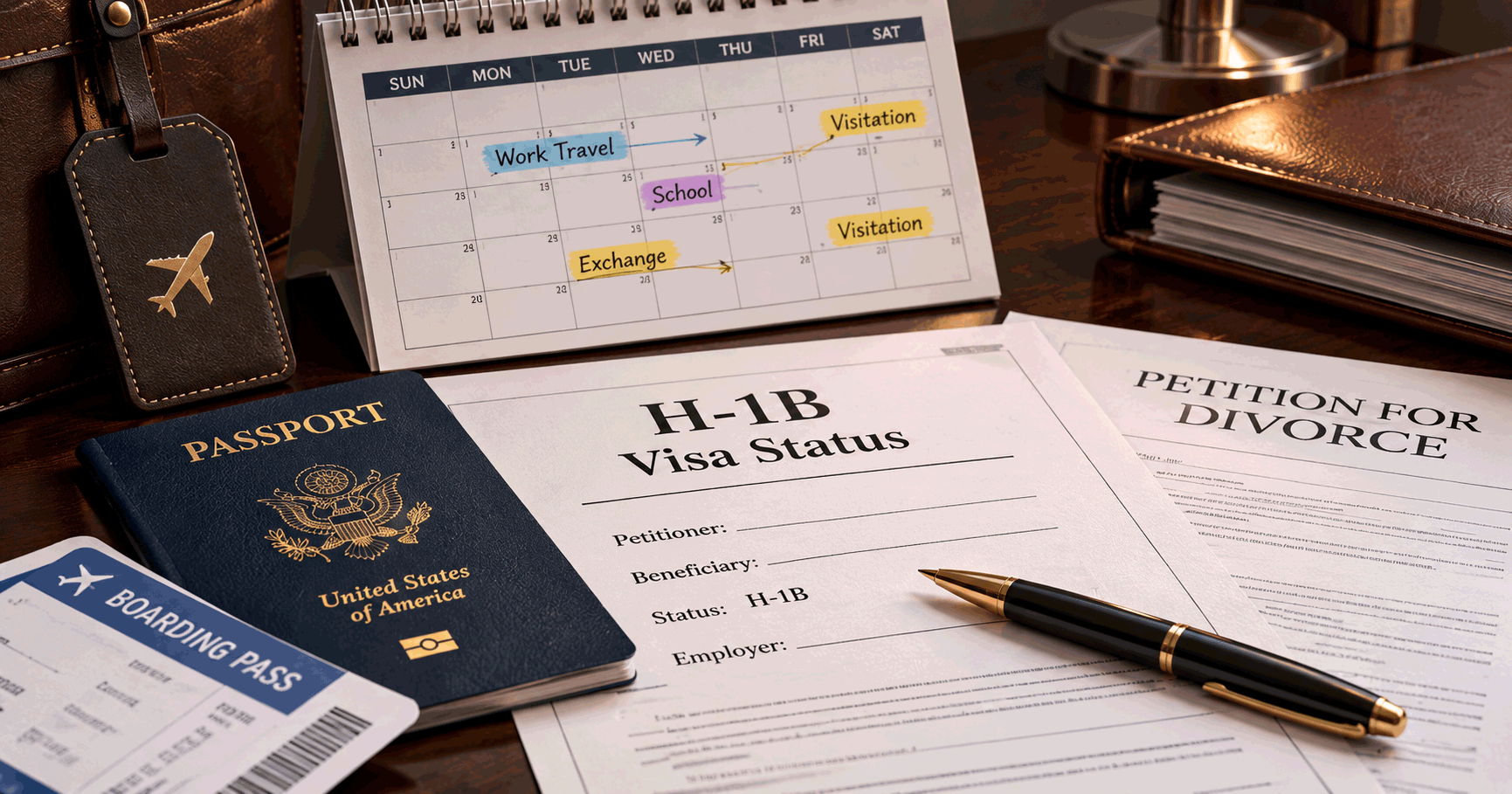
| Short answers A California or Texas family court can end the marriage, divide property, set support, and make custody and parenting orders. It does not decide anyone’s visa, green card, or right to stay in the United States. Those questions belong with an immigration attorney. Because timing can matter, talk with an immigration attorney before anyone files, if a visa or pending green card case is part of your family’s picture. |
Many Indian American families we hear from are U.S. citizens or green card holders, and visa questions are not part of their divorce at all. If that describes you, you may find more useful information in our posts on whether a U.S. divorce counts in India, how courts treat wedding gold and stridhan, custody orders and travel to India, and wills and gifts for families with ties to two countries (links below).
This post is for families where an H-1B or H-4 visa is part of the picture. When a marriage is ending and one spouse’s visa is connected to the other’s, it is natural to wonder what a divorce court will decide. The short answer: the family court decides family matters. It does not decide immigration status. Knowing where that line sits can help you ask the right questions of the right lawyer.
What does a California or Texas family court decide?
Whatever anyone’s visa type, a family court in either state handles the same core issues:
- Ending the marriage. California calls this dissolution, and has a minimum six-month waiting period before the marriage can end (California Family Code §2339 [CH verified]). Texas calls this divorce, and generally requires at least a 60-day wait after filing before a divorce can be granted (Texas Family Code §6.702)
- Dividing property. California generally divides community property equally (California Family Code §760 and related sections). Texas divides the community estate in a manner the court finds “just and right” (Texas Family Code §7.001). In both states, gifts and inheritances to one spouse are generally separate property.
- Support. Child support follows each state’s guideline (California Family Code §4055; Texas Family Code §154.125). Spousal support in California and spousal maintenance in Texas have their own factors and limits (California Family Code §4320; Texas Family Code chapter 8).
- Custody and parenting time. Both states decide based on the child’s best interests (California Family Code §3011; Texas Family Code §153.002. Orders can also address travel, passports, and who keeps important documents.
What doesn’t the family court decide?
A divorce judge in California or Texas does not grant, cancel, or extend a visa, and does not decide a green card application. Questions such as whether a person can remain in the United States after a divorce, what happens to an H-4 or an H-4 employment authorization document, or how a divorce affects a pending green card case are immigration questions. They are decided under federal immigration law, and our firm does not give immigration advice.
What we can say is that the order and timing of events in a divorce can matter to those questions. That is why we encourage anyone whose status is connected to a spouse’s visa or petition to speak with an immigration attorney before a divorce is filed, and to keep that attorney informed as the case moves. Some families ask their family law attorney to coordinate with an immigration attorney as the case proceeds. We can accommodate that, however, keep in mind that our firm does not practice immigration law. An immigration attorney should advise on status questions.
| A note on recent news In 2026, news outlets reported that the Department of Homeland Security placed a proposal to end work authorization for some H-4 spouses on its regulatory agenda. As reported, no final rule had been issued and existing work permits remained valid. If this affects your household, an immigration attorney can tell you where things stand. In the divorce itself, the family court looks at each spouse’s actual income and earning ability under state law when it sets support. |
Can I file for divorce in California or Texas if I am not a U.S. citizen?
Residency rules for divorce are about where you live, not your citizenship. California generally requires that one spouse has lived in the state for six months and in the county for three months before filing (California Family Code §2320). Texas generally requires six months in the state and 90 days in the county (Texas Family Code §6.301). Whether filing is the right step at a given time is a separate question to discuss with your family law and immigration attorneys together.
What if there is abuse or fear at home?
Protective orders are family-court tools available in both states regardless of a person’s immigration status (California Family Code §6200 and following; Texas Family Code chapter 85). If you are in immediate danger, call 911. An immigration attorney can also talk with you about any protections that may apply to your status. You do not have to choose between safety and asking questions.
Practical steps before anyone files
- Gather your own copies of important documents: passports, I-797 notices, I-94 records, marriage certificate, children’s birth certificates, tax returns, and account statements in both countries.
- Make a list of assets in the United States and in India, including bank accounts, retirement accounts, real estate, and gold or jewelry. Both states require full financial disclosure in divorce.
- Book separate conversations with a family law attorney and an immigration attorney, and give each permission to coordinate. Another option is for the family law attorney to bring an immigration attorney into the matter as needed, for a paid consultation, a separate case, or, in limited situations, a narrow joint appearance.
- If privacy matters to your family, ask about mediation or other settlement options. Court filings are generally public records in both states, so confidentiality is something to discuss with your lawyer rather than assume.
Frequently asked questions
Will the divorce judge decide whether I can stay in the United States?
No. A California or Texas family court decides family matters such as property, support, and custody. Immigration status is decided under federal law. Please talk with an immigration attorney about your status.
Can we wait to divorce until a green card case is decided?
Timing is a question to plan with both a family law attorney and an immigration attorney. Each state has its own waiting periods and procedures, and courts manage their own calendars.
Timing can matter. Whether filing for divorce soon after a grant of status has immigration consequences is a question for an immigration attorney who can review your facts. Our firm does not practice immigration law and cannot say how a filing will be reviewed in California or in Texas.
Does my visa type change how property or custody is decided?
The property, support, and custody rules are the same state rules that apply to every family. Practical facts, such as where family members may live in the future, can come up in custody planning.
Do I need to be a U.S. citizen to file for divorce here?
No. Filing depends on residency in the state and county, not citizenship.
Where we practice
Carla L. Hartley is licensed in California and Texas and practices family law and probate at Hartley Vojtik Law Group in Ventura and Arlington. The firm handles family-court matters in both states and can coordinate with a client’s immigration attorney, tax professional, or counsel in India on the family-law side. The firm does not practice immigration law or Indian law.
If you’re not working with us, work with someone who knows this area of law.
Attorney advertising. This article is general information about California, Texas, and federal law as of the date of publication. It is not legal advice, immigration advice, and reading it does not create an attorney-client relationship. Every family’s situation is different, and laws change. Hartley Vojtik Law Group does not practice immigration law or Indian law. Responsible attorney: Carla L. Hartley. Carla L. Hartley, licensed in California and Texas; R. Benjamin Vojtik, licensed in California and Texas. Hartley Vojtik Law Group, Ventura office: 1601 Eastman Avenue, Unit 205, Ventura, CA 93003. Arlington office: 2366 E. Road to Six Flags St., Arlington, TX 76011.
| About the author Carla L. Hartley is the founding and managing partner of Hartley Vojtik Law Group and is licensed to practice law in California and Texas. She was admitted to the State Bar of California in 2007 (SBN 249362) and the State Bar of Texas in 2022 (SBN 24128394). She handles family, probate, and estate matters through the firm’s offices in Ventura, California, and Arlington, Texas. Read Carla’s bio. |